10 Nov 2026
•
5 min read
Why sustainability is intimately tied to efficiency.
We all know flying and eating meat take a toll on the planet.
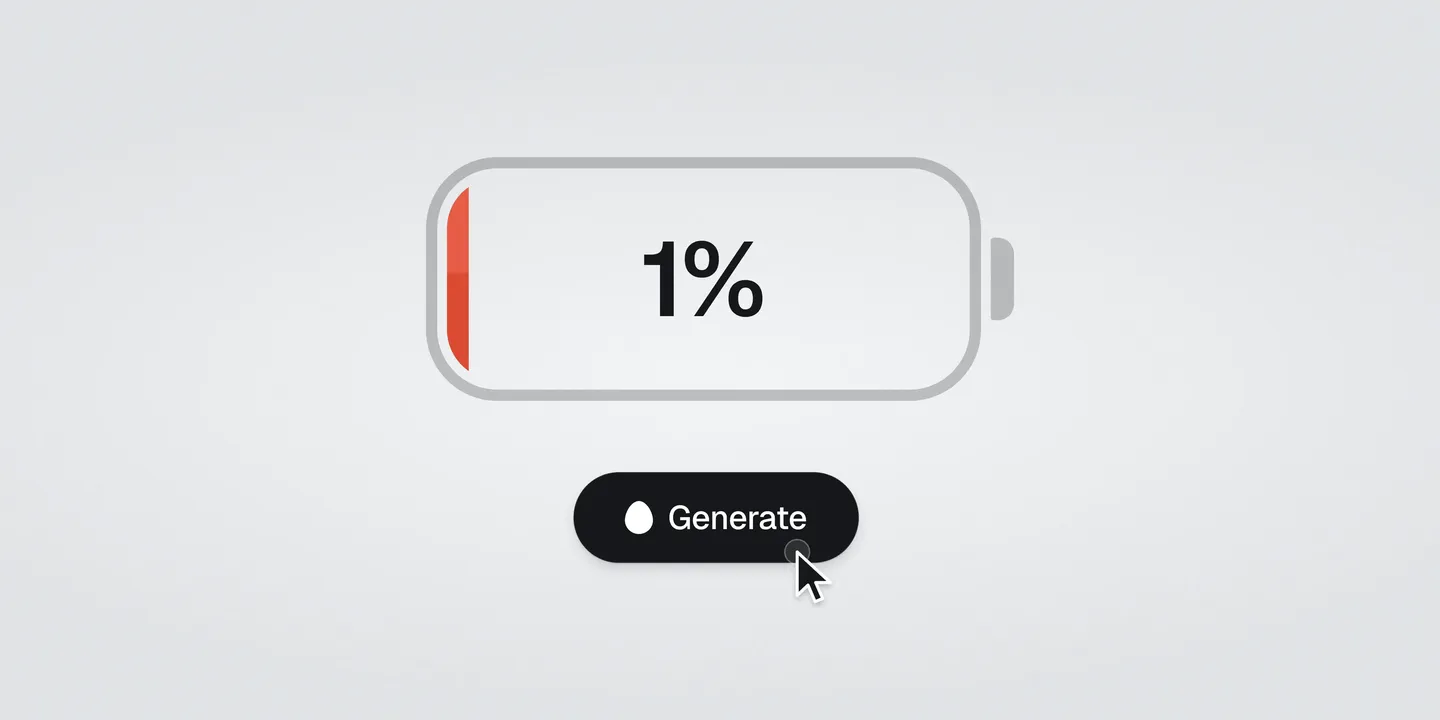
But did you know that the digital sector produces somewhere between 1.5% and 4% of global emissions, depending on who's counting, which puts it in the same league as aviation?
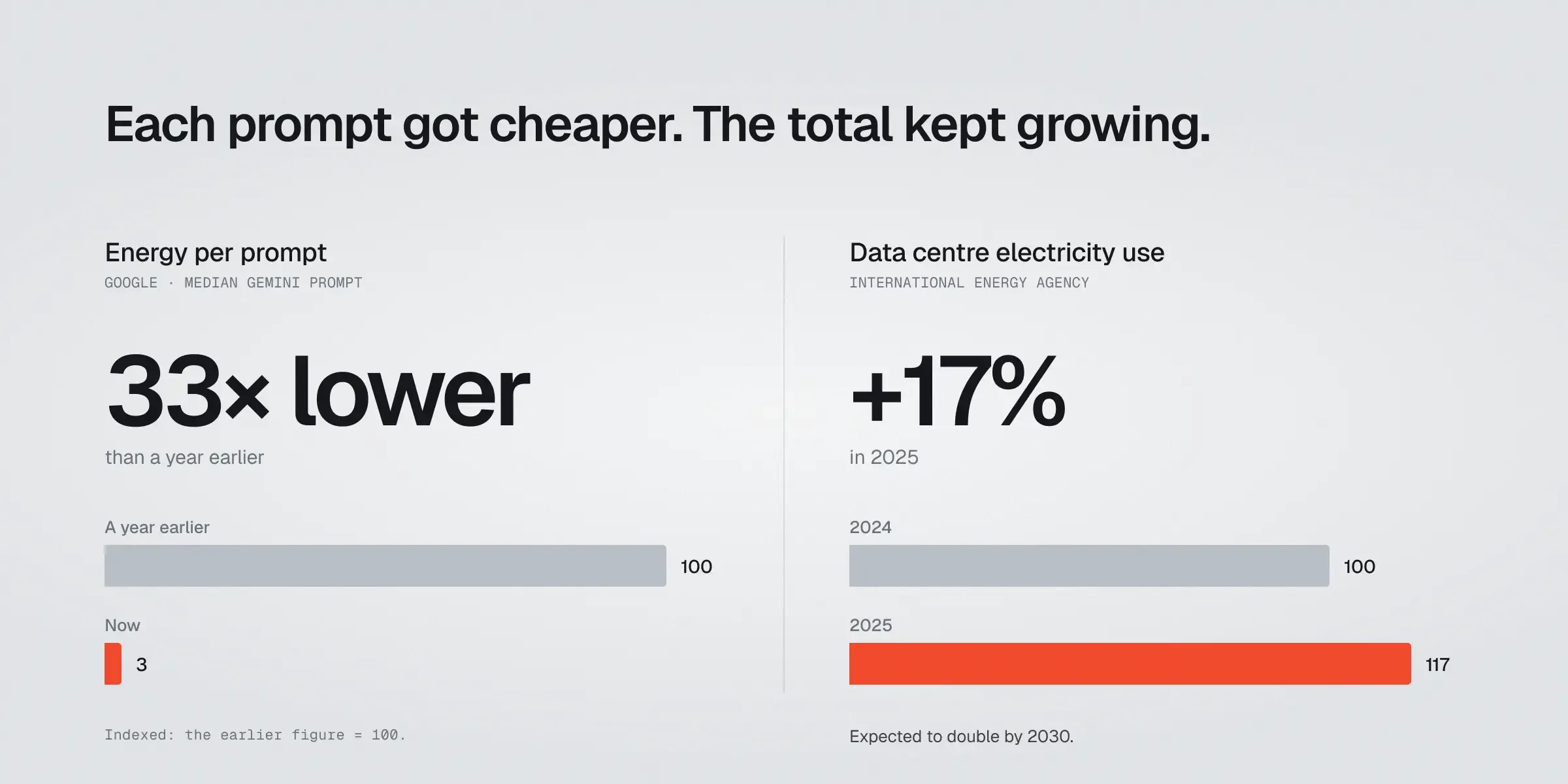
Lately, our feeds have been flooded with videos of the noise AI data centres make and the trees cleared to build them, while people living nearby report their water getting worse. The conversation has moved on from what a single prompt costs to what the buildings behind it do to the places around them, and the numbers explain why. Meanwhile, each prompt is getting cheaper to run, at least by Google's own account, which puts the energy behind its median Gemini prompt 33 times lower than a year earlier. Total demand has climbed regardless. The International Energy Agency found that data centre electricity use rose 17% in 2025 and expects it to double by 2030, as heavier uses like video generation and AI agents outweigh the gains made on each task.

A.I.’s Environmental Impact Will Threaten Its Own Supply Chain
How the A.I. industry is scarring the earth and leaving humans in the lurch, jeopardizing its own future and ours.
What these buildings cost the places around them is easy to see if you live next door, and almost invisible to everyone using what runs inside them. On a recent episode of the Ask MIT Climate podcast, Costa Samaras, who directs Carnegie Mellon's Scott Institute for Energy Innovation, pointed out that noise is a pollutant in its own right and that water use matters most where local supplies are already under stress. On the same episode, Vijay Gadepally, a senior scientist at MIT Lincoln Laboratory, described a story app he built for his son a couple of years ago, where each illustrated story used about as much energy as the iPad's whole battery, spent in a data centre somewhere else. "If every time he pressed 'generate story', the iPad's battery died," he said, "I'd probably have that immediate signal."

The Climate Impact of Generative AI
Vijay Gadepally talks about what the research community and consumers do to help mitigate its environmental impact.
The people designing digital products don't get that signal either, which is why we think the decisions that matter most are made long before anything reaches a data centre. “Efficiency measured one prompt at a time makes it cheaper to do more of everything, so the kind of efficiency that reduces impact starts with deciding what deserves to be built at all and AI makes those decisions more pressing, because whatever becomes cheap to produce tends to be produced in greater quantity. As Gadepally put it in an earlier Ask MIT Climate piece, "We're doing billions of these things a day. So even a small change, when you multiply it by the number of times we're doing it, can be quite large.”
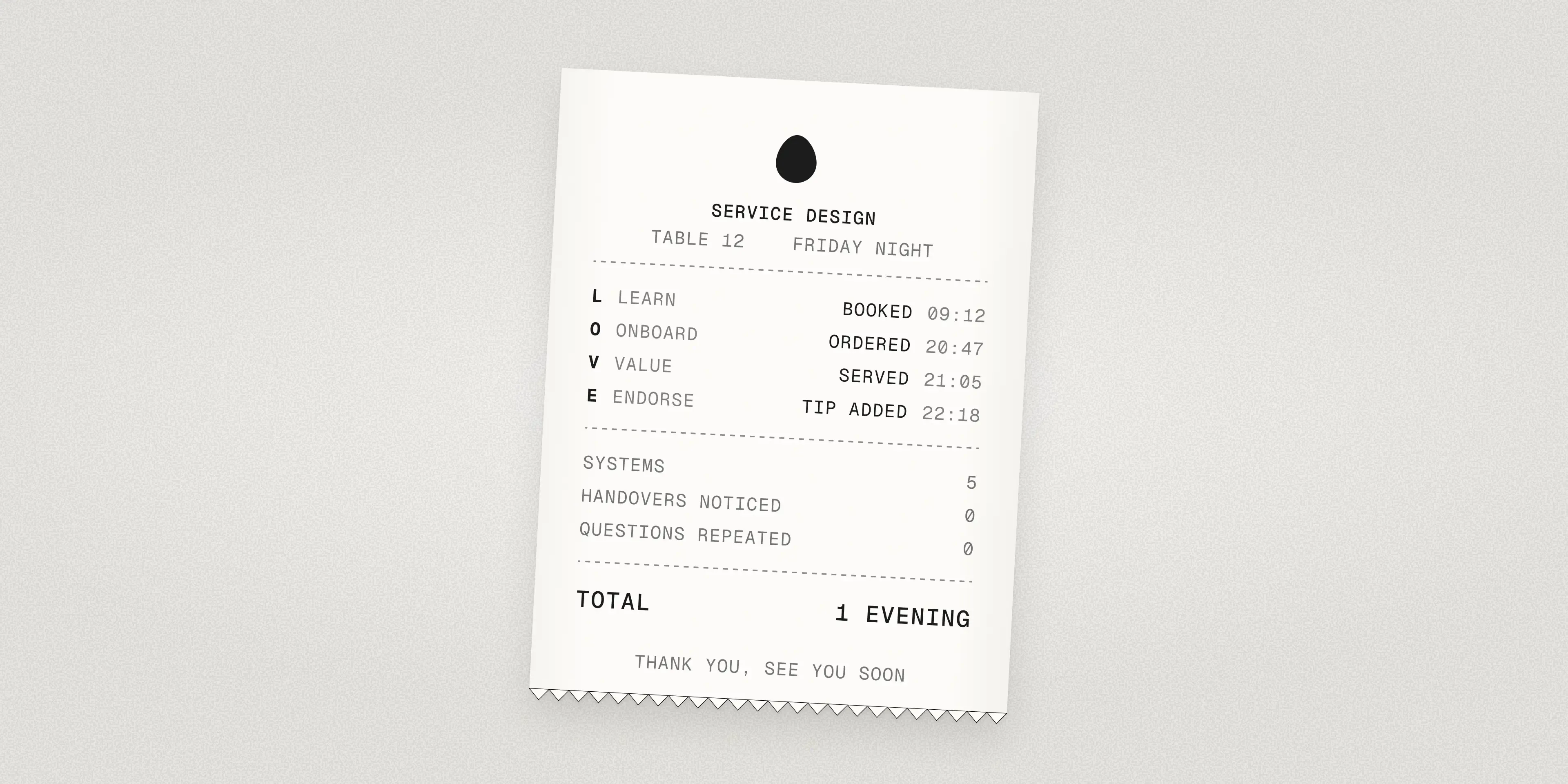
Deciding what deserves to be built starts with the people using it.
Our LOVE framework asks whether they can quickly learn what a product does, get started without friction, get clear and recurring value, and end up recommending it.
Deciding where AI belongs
We're part of this demand ourselves. Much of the conversation around AI carries a feeling that there's no escaping it, and for most teams, ours included, opting out altogether isn't realistic, which makes how and where it gets used the question worth our attention.
Our rule at Significa is that AI is there to help us move faster, and the time it saves goes back into thinking and quality, never into squeezing margins. Designers and engineers use it as much as our marketing team does, each in the way their work calls for, so there's no single method to follow. What we share across the company is a simple test, written into our internal guidelines, for deciding when to reach for it: does the task need our judgement, or would it just benefit from structured help? If it needs our judgement, we do it ourselves, and if not, we use the tools and stay critical of what they produce.
The Shift Project reaches the same conclusion from the infrastructure side. Years of optimisation by AI developers haven't stopped the footprint growing, so it recommends that organisations judge each use case on its merits and be ready to modify or remove features that can't justify their cost, even when the better option turns out to be a simpler tool with no AI in it.
Building near-functional prototypes around a discovery workshop is one use we keep coming back to, and it shows what deliberate use looks like in practice. As Tomás Gouveia, our marketeer, describes in his article on prototyping with AI, the same instruction opens every session: "You build; you do not decide product, you do not change scope, you do not invent features. If something is not defined, ask before building." Left to its defaults, a model fills every gap it finds, so the rule keeps it from producing features nobody decided on. On a recent project, that still meant a navigable prototype covering 61 routes two days after the workshop, where static wireframes used to take about a month, and one round of adjustments with the client is usually enough.
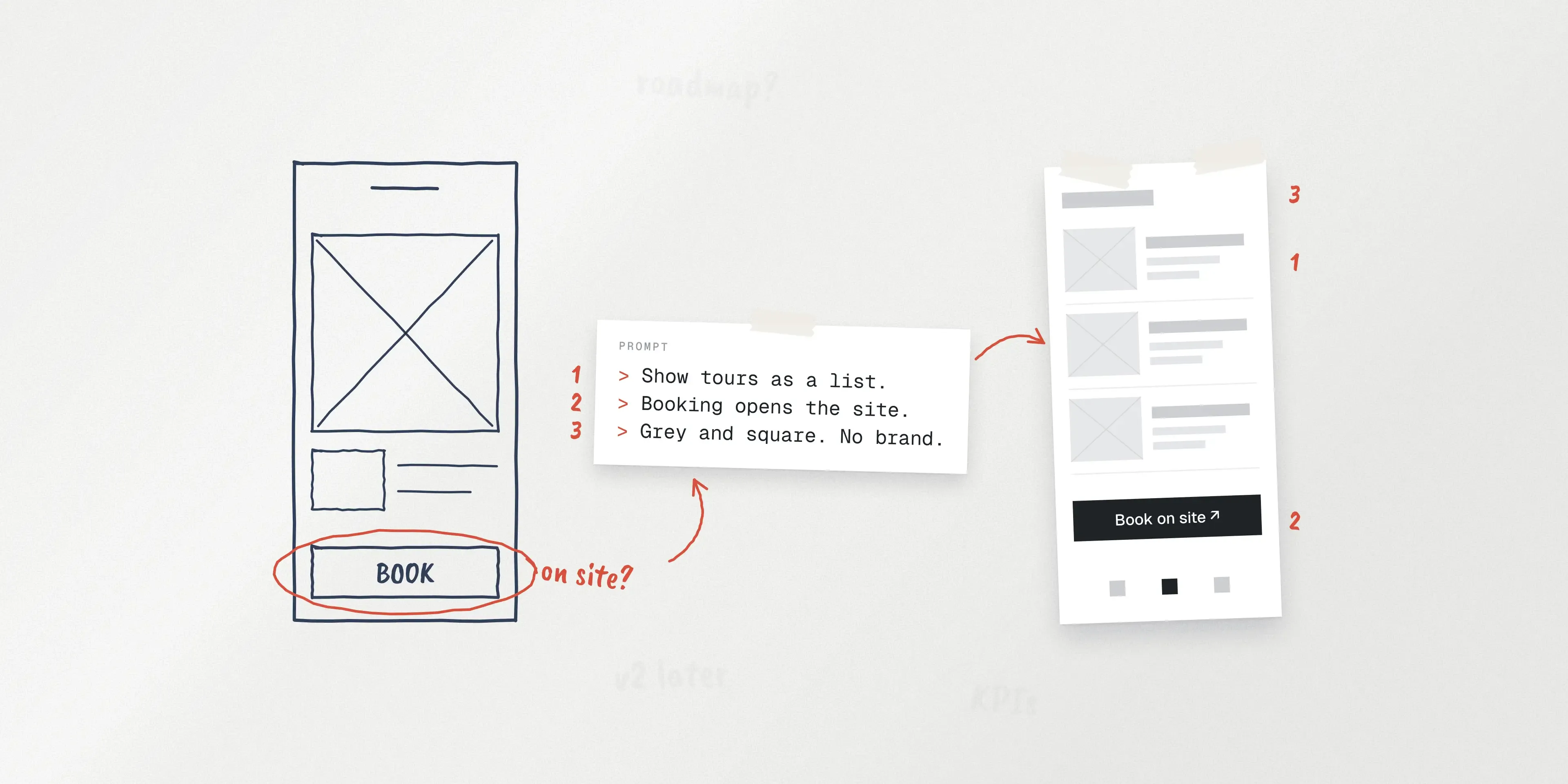
From overwhelming spreadsheets to clickable prototypes
Where wireframes used to take a month to complete, we can now get an overview of a product much quicker and use that time for creativity.
Nimble experiments
Deciding what deserves to exist applies to what AI helps produce, too. Our work with Hey Harper shows what that can look like. Their marketing team now builds campaign landing pages with Claude Code, each in a sandboxed folder that can't reach the cart or checkout, and launches or pulls them with a publish switch in Storyblok. Experimenting remain cheap, since a page that doesn't perform comes down with a click. When one wins, it comes back to our engineers to improve with the data behind it, so the ideas that last are the ones that get proper investment and the store doesn't fill up with pages nobody visits.
Questions worth asking
Before adding AI to a product or a workflow, it helps to know what it would replace and whether anyone would notice if it were switched off. How often will it run once real users arrive, and does the task need the largest model available? Could a simpler tool do the job with no AI in it at all? If the answers are vague, the feature probably isn't ready to be built.
Building deliberately
Offsetting and ESG reporting have their place, although neither changes how much energy a product uses once it's live. That depends on choices made much earlier, about what to build and whether it needed AI in the first place, and those choices sit with the people designing and engineering it.
Making them deliberately can feel slower than letting a model generate whatever is asked of it, and it asks teams to admit that some of what they've built never needed to exist. We hold ourselves to the same test. We intend to stay small and still be here in thirty years, and that only works if the way we build is something we can sustain, for our clients' products and for ourselves.
Ana Fernandes
Brand Manager
While others struggle to keep up, Ana effortlessly leaps from one thing to the next in a turbo-charged, blazing fast, whirlwind of flaming ideas and effortless creativity. After a couple of years managing projects, Ana moved into brand & product marketing. Now she shapes how Significa communicates with the world, keeping our voice clear, consistent, and genuinely ours.
We build and launch functional digital products.
Related articles
Tomás Gouveia
Marketer
Tiago Duarte
CPO
27 October 2026
•
6 min read
Significa
Team
23 October 2026
•
6 min read