23 Oct 2026
•
6 min read
Service design, or how to build products people LOVE.
A user never experiences your brand, your product, your service and your systems separately. Their experience is whole, and it should be designed as such.
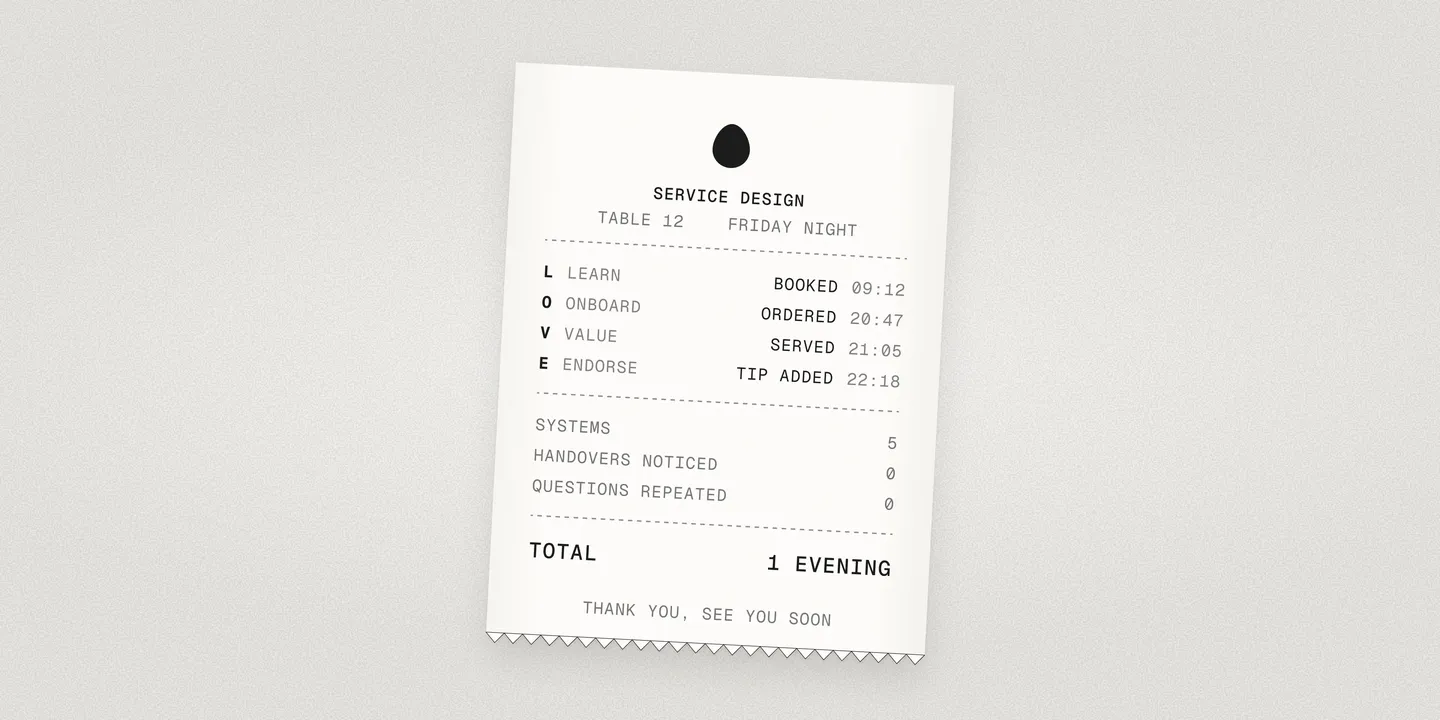
Picture a full restaurant on a Friday night. A guest booked a table this morning, orders from a menu the waiter carries on a tablet, adds a dessert the kitchen sees the moment it's tapped, pays without waiting for the bill, and tips on the same screen on the way out. To the guest, that was one smooth evening. Behind it sat a booking system, a point of sale, a kitchen display, a payment terminal and staff under pressure, and the guest noticed none of it, which is precisely the point.
Most digital projects are scoped the other way around: piece by piece, each system bought or built on its own logic, each one working in isolation, and the gaps between them left for users to bridge.
Now take the same Friday night somewhere else: a waiter asks about an allergy the booking already recorded and the kitchen misses a modification, so guests spend the evening repeating themselves. No single system is broken, yet the evening disappoints, because nobody designed it as one. What separates the first restaurant from the second is service design.
“Service design is 10% design, 90% creating the conditions for design to happen.”
Lou Downe
Former Director of Design for the UK Government
What is service design
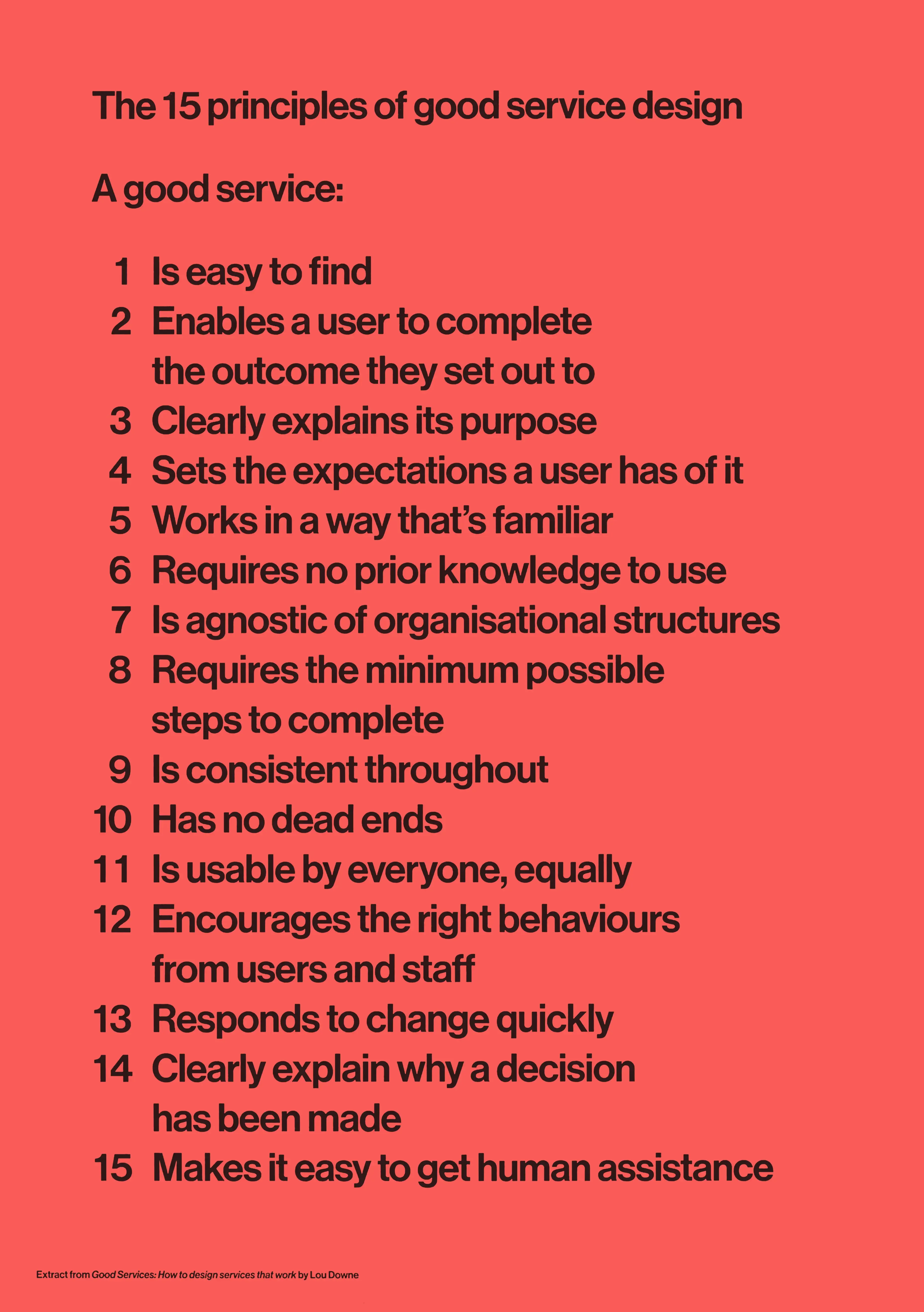
Service design is the discipline of designing the entire experience as one system, front of house and back. Where product design shapes what a person sees and touches, service design also covers the people, processes and operational logic that make each moment possible: in the restaurant above, the waiter's route between tables gets designed as deliberately as the screen they tap when they reach one. The Nielsen Norman Group frames service design as planning and organising a business's people, props and processes to improve the employee's experience first, and through it the customer's. Employees come first in that definition for good reason, since services usually break on the staff side long before a guest feels it. Lou Downe’s Good Services: How to Design Services That Work, is the clearest introduction to the discipline we know, and well worth reading whether or not you design for a living.
Service design in practice
Building allO, an all-in-one restaurant platform we've worked on since its first version, showed us that every design decision is a service decision before it is a screen decision. The point of sale adapts to the state of the service, showing what the moment requires instead of everything it could. Rush Mode exists because a kitchen at peak is a different operation from a kitchen at four in the afternoon, and we designed for each. And when we tested the product with the restaurant teams who use it daily, buttons beat the swipe gestures that convention favoured. Everyone knows how to swipe, but a packed Friday night rewards speed and certainty over elegance.
The results are the kind only service design explains. Ordering waits fell by fifteen minutes, back office work shrank by twenty-five minutes a day, sales grew by 30% and tips rose by 62%. Some of that tip increase may come from tipping being one tap away at payment, but tips are also the most direct verdict guests give on an evening, and a service that runs faster and calmer leaves staff with more attention for the people at their tables. That is structural and operational impact, and it's the standard a digital product should be held to.

allO: run the restaurant your guests love.
The full case study, from point of sale to Red Dot.
The same discipline at every scale
Restaurants make our argument easy to see, but it doesn't apply to hospitality alone. On match day at a stadium, a fan buys a ticket during the week, gets directions that morning, scans in at the gate, finds their seat, orders a drink to it at half-time, and earns something for coming back. That chain crosses ticketing, access control, payments and live operations, and at its best it feels like one gesture. A manufacturer lives the same problem at a slower pace, with buyers who start from a search, increasingly a question typed into an AI assistant, land on a product page, request a proposal, and then spend weeks in conversation with a commercial team. Even a wholesale client placing a repeat order is inside a service, one that has to confirm their negotiated prices and stock before it can tell them when the delivery will arrive. In every case the value lives in the transitions, and transitions are exactly what nobody owns unless someone designs the chain as a whole.
How to measure impact without revenue metrics.
Tips, waiting times and returning guests are behaviour metrics that show more than conversion alone.
LOVE Framework
Over the years, this way of working condensed into a framework of our own. We call it LOVE, and it’s how we test a product and the service around it. It stands for Learn, Onboard, Value, Endorse, and it works as a practical lens on any product or feature: can people quickly learn what it does, get started without friction, get clear and recurring value, and end up recommending it?
It applies at two levels. At the product level, every piece of a digital ecosystem answers those four questions on its own terms. Take the ordering flow in that restaurant from the waiter’s side: someone on their first shift should understand it within minutes, take an order without calling anyone over, see it reach the kitchen exactly as entered, and trust it enough on a packed Friday to reach for it before a notepad. Run the same test on the booking system or the payment step, and each one either passes or shows you precisely where it fails.
“Clients rarely come to us asking for service design. They come with a slow checkout, or an app nobody opens. Service design is how we find out what’s behind them.”
André Resendes
CDO
At the system level, the question changes: how does a user move from booking to ordering to paying without feeling the handover between products? Data should flow so users never repeat themselves, and each interaction should build on the last instead of fragmenting the whole. Think of Apple: every product works on its own, and the reason people stay is how they work together. When each product passes LOVE on its own and the system passes it as a whole, the result is a service people come back to and recommend.

How fast should your product deliver results?
The answer is: earlier than you think.
Service comes first
A platform chosen before anyone understands the operation tends to clear the wrong bottleneck and only then choose the technology, down to the device itself. The order that works is the same at every scale: understand how the business runs and where it's going, design the service users should experience across every touchpoint, and only then choose the technology in the widest sense of the word, the platform, the stack, even the device, because Whether something belongs on a phone, a laptop, a till behind the bar or a watch on a wrist is a service decision before it is a technical one, and by then the choice comes more easily, because you know exactly what you’re choosing it for.
Significa
Team
Think, Design, Develop, Launch. Write. Repeat. Enjoy our collective musings coming from across our product, design and development teams, all in a neat blog post for you.
We build and launch functional digital products.
Related articles
Rui Sereno
CEO
Rui Sereno
CEO
Rui Sereno
CEO
10 August 2026
•
4 min read