20 Apr 2026
•
6 min read
Nostalgia for a job I still have.
At an all-hands meeting a few weeks ago, we were discussing a batch of digital products the team built in a couple of days. Even though I nodded along in awe, I went home feeling like the floor underneath me had tilted.
It's not that I'm frightened we'll all be losing our jobs soon. It was more like... what's the point now? I kept coming back to that timeline, from idea to launch, in three days. Work that would have taken weeks, compressed into a long weekend.
I couldn't quite put what I was experiencing into words, which is inconvenient when a nagging feeling won't leave you alone. So I went looking for other people's words instead, and I found a handful of essays written by developers, most of them decades deep in their careers, all circling the same question: what happens when the thing you've built your working life around starts to feel like it will never be the same?
Before AI…
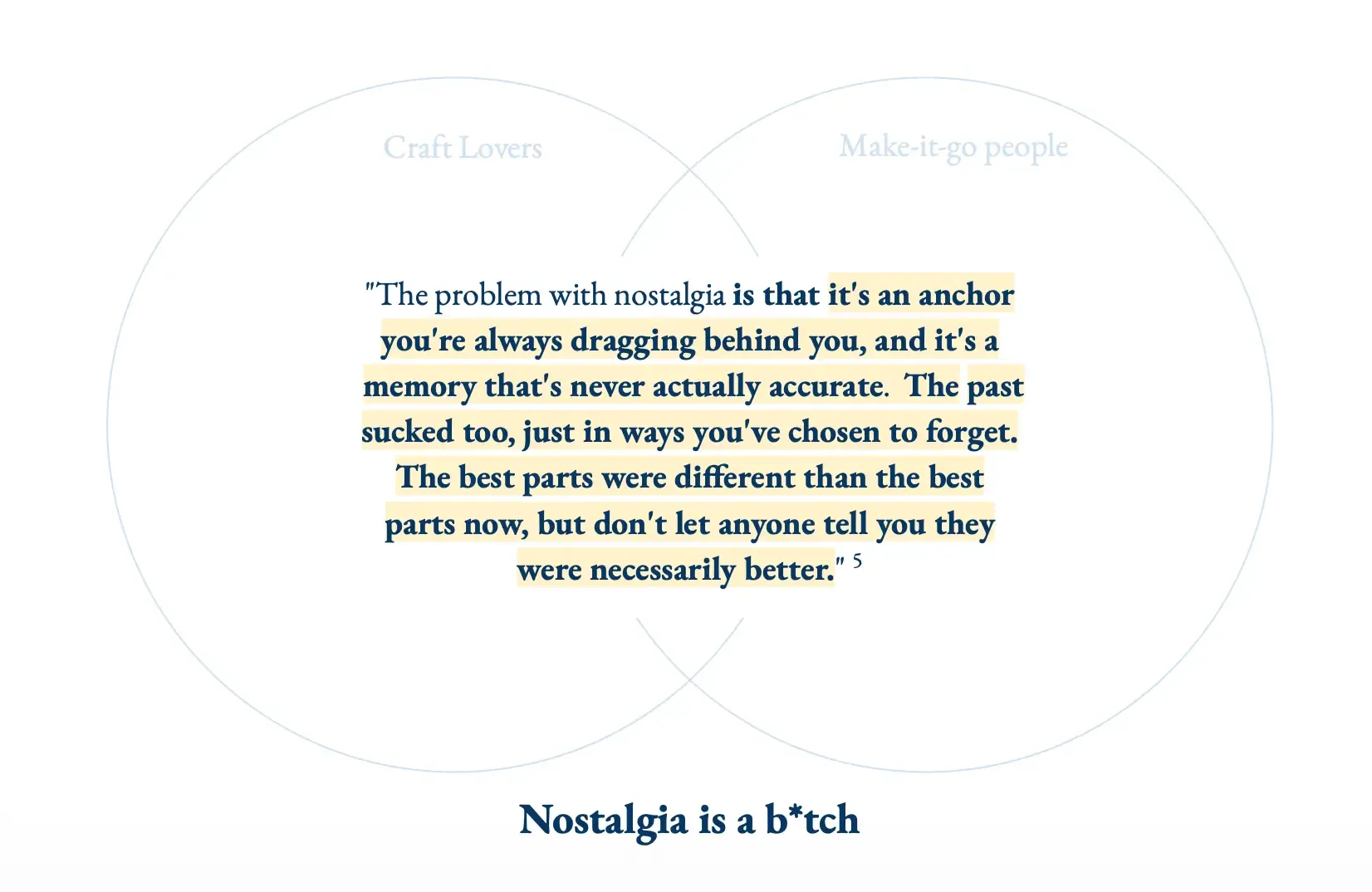
Les Orchard wrote about this in his essay Grief and the AI Split, and this idea stuck with me ever since: before AI, two very different kinds of developers sat working side by side, and not much would tell them apart.
Some loved writing code and relished in the elegance of a well-structured function, appreciating the slow, absorbing focus of wrestling with a bug until it is caught. Others simply loved building stuff that worked, and code was how they got there. Both used the same editors, the same languages, the same pull request workflows.
Now, you can choose to hand the coding to AI, spending time directing, reviewing, and deciding how the code evolves instead, or continue doing it all by yourself. It doesn’t mean you’ll always go for one or the other, nor that you have to “pick a side” and stay there.
Bear with me: at work, I care about the quality of the code itself. I want the functions to be clean, variables to make sense, and the architecture to hold up when someone else picks it up months later. But I'm also building a side project with friends right now, and an app that would have taken us at least a year has now been running for weeks with the help of AI. In this case, I honestly don't care what the code looks like. I care that the ideas behind building that product are becoming real, that things are happening fast, and that we're having fun doing it.
I think the tension between these two worlds is part of what makes this moment so hard to talk about… there's no clean position to take, and the loss of coding and the excitement of building come hand in hand.
Different mo(u)rnings.
The developers whose essays I found are mourning different things, and so am I.
Some of them miss hands-on work, the texture of building something line by line. I recognise that… A few years ago, in college, you'd hit a bug and spend three days trying to figure out what was going on. Three days on one problem!!! At the time, it wasn't fun, but it was slow in a way that demanded you to enter a sort of flow state which was precious and rewarding.
Now, I’m able to do ten different things on the same day. Even though I get more done, the pace of my day feels different, and there is something about the quality of my attention that has changed with it. I’d be lying if I said I didn’t miss the slowness development engineering used to carry with it. And while I don’t necessarily miss the frustration of not being able to debug a feature (AI is indeed great at helping with that), I miss the depth of focus that those tasks demanded.
We are also mourning something harder to name: for a long time, there was a clear relationship between experience and recognition. You put in the years, you deepened your understanding, and that showed in your work, in ways that peers and clients could see and grasp. Your seniority was tangible, because the gap between what a junior and a senior could produce was obvious.
AI blurs that line. When someone with two years of experience can produce output that looks, on the surface, like what took you ten years to learn, that gap doesn't disappear, but it does become harder to recognise from the outside. The architectural thinking, the instinct for where things will break, the thousand small decisions that make something robust beyond functional... all of that still matters. But it’s only natural that when value becomes harder to point at, it becomes harder to feel.
Work vs worth
After I gave the talk, my colleague Nuno Polónia offered a different perspective. Not regarding my feelings per se, but on what sits underneath them. His argument caught me off guard, because it reframed the whole conversation in a way I hadn't considered.
“Since we spend a third of our day at work there is an association between what we do and who we are, and we attribute some, and in some cases a lot, of our self worth to what we do. I think that's normalised, it's celebrated and it is awful. There's nothing wrong in having pride on what you do or if you don't care about what you do. Knowing quickly how to apply a Djikstra algorithm to a graph tells me nothing about you and you aren't anything more as a person for being able to do it. So when I hear about "the craft lovers that are in grief" I hear them, I feel for their sorrow, but I don't think the problem is the AI, it's the thought that it will take part of their humanity or value away and I'd love them to shed that thought.”
Nuno Polónia
Developer
I understand his point, and there's real wisdom in it. But deciding that work shouldn't define you is one thing. Actually untangling years of building your identity around it is another. There's room for grief, and also for questioning the attachment that feeds it, neither cancels the other out.
On the brighter side.
There are things AI genuinely can't do, at least not yet. It doesn't have taste, an eye for design, and it can't hold an entire system in its head and tell you where it could possibly fracture six months from now either. It also doesn't know why one solution is elegant and another is merely functional.
As code generation becomes cheaper, what matters most is the rationale around the code. Knowing what to ask for, spotting when something is subtly off, seeing how pieces fit together and where they don't. That kind of judgement comes from experience, and it's arguably more valuable now than ever before.
As Les Orchard put it in Making Computers Do Things is Fun, these tools also lower the barrier to getting started with any project, which is something I didn't expect to appreciate as much as I do. Ideas that sat on the back of our minds for years because building and maintaining them was too complex can now become reality. Plus, on those days when my energy is low and motivation is nowhere to be found, I can still move things forward.
That said, there's a reality check worth keeping in mind. One of the developers I read described seeing a young engineer on LinkedIn, only a few years into their career, lamenting that with AI in the picture they didn't know what was “going on” anymore. His response was sharp: that person was already writing code that runs through layers upon layers of abstraction they've never thought about, pulling in hundreds of packages they've never opened. The idea that any of us truly understood the whole stack was always a comfortable fiction, and AI is just the layer that made it impossible to keep pretending.
The thrill isn’t gone!
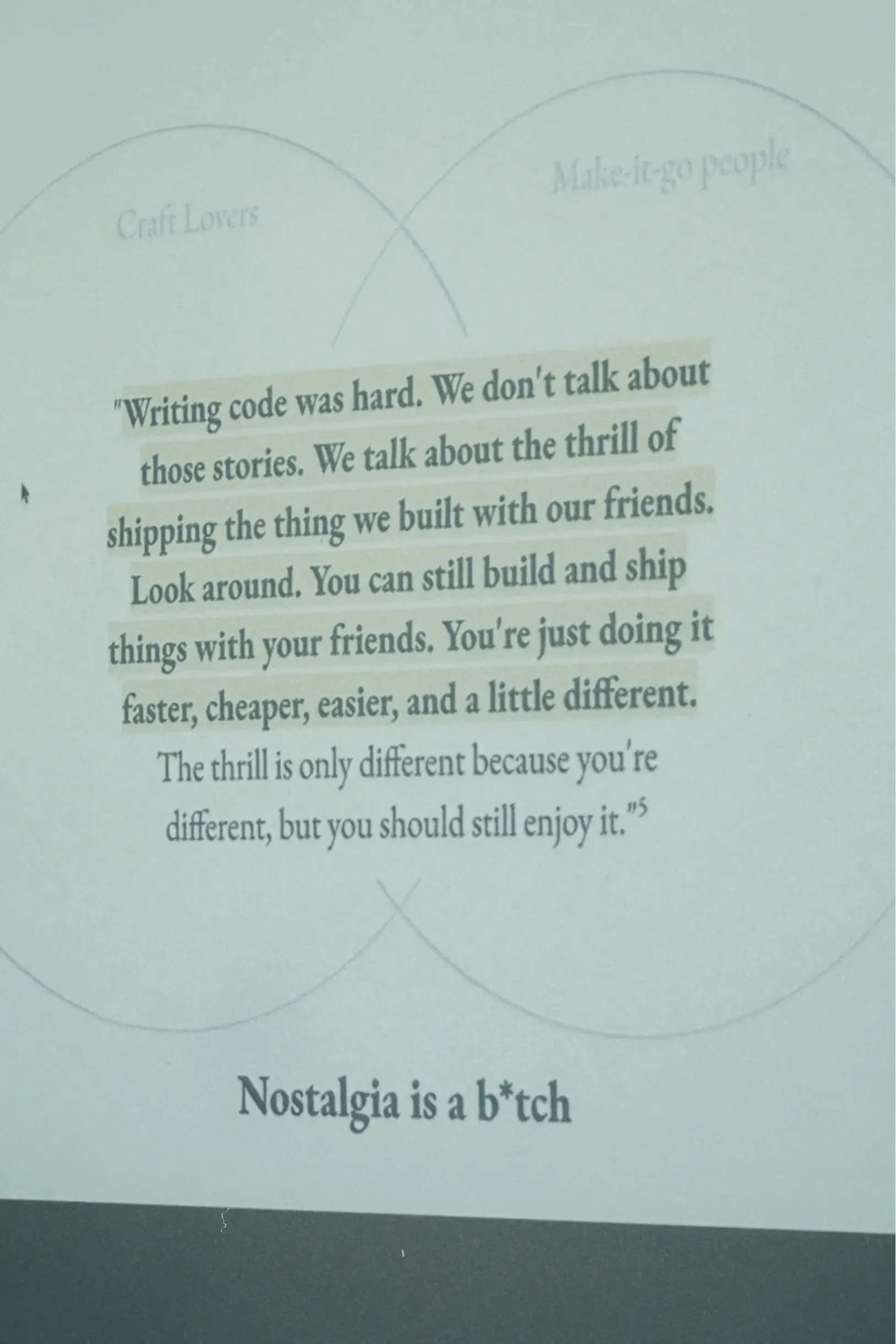
Let’s face it: work feels different now. I'm not necessarily referring to tools, nor outputs, or day-to-day responsibilities either. I mean the way work sits with you at the end of the day. Think of the particular satisfaction of building something with your own hands and knowing exactly why every piece is where it is... that's harder to come by. Now, we get to feel the thrill of watching an idea you thought was too ambitious actually come to life, and the freedom to start projects we never would have attempted. That’s huge in itself! The conversations we're having now, as a team, about what we value and why, those wouldn't have happened without the shake-up AI brought along.
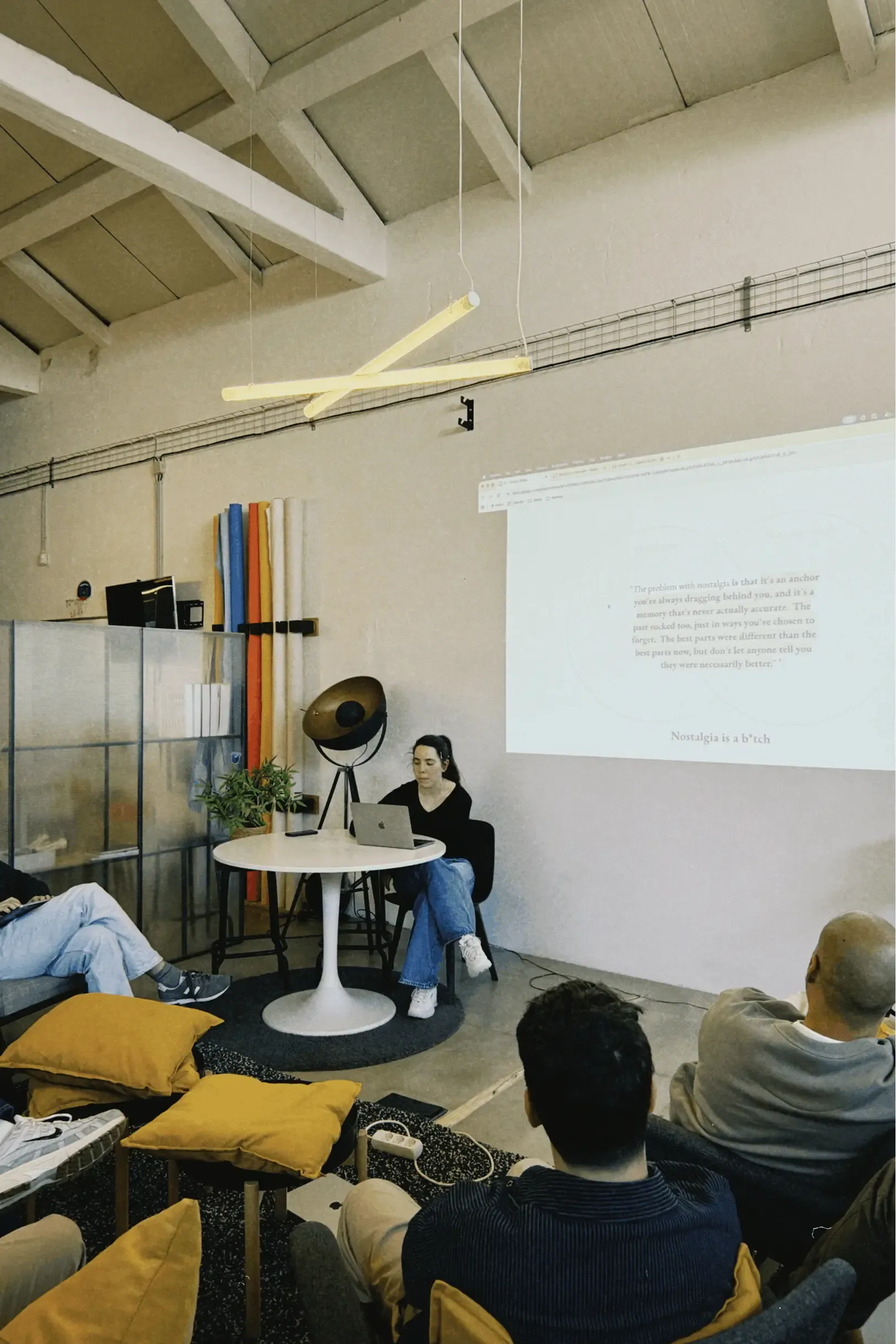
I gave this as a talk at Significa because I needed to process what I was feeling, and it turned out most of the team was working through some version of the same thing. That alone made it worth doing. Of course, naming a feeling doesn't fix it, but it does make it lighter to carry, especially when you realise you're not the only one holding it.
The truth is we're not going back to those three-day debugging sessions (I'm not sure I'd want to, to be honest). But the feeling of slowness and the depth of attention from getting into the flow state that this work used to demand... that loss is worth acknowledging and sitting with. As humans, we have to allow ourselves to recognise this complexity so we can keep building stuff that can have a positive impact on our lives, no matter how long it took to launch.
Our work is changing, and we're changing with it. That's allowed to be exciting.
Julieta Frade
Front-end Developer
When she’s not watching F1, you can find Julieta in the gym, likely thinking about what needs to happen to stop Verstappen from winning yet another world championship. She's definitely not fuelled by Red Bull but by the desire to solve problems (like that Verstappen guy…). That's why she’s awesome at smashing out top-quality Front-end code at Significa.
We build and launch functional digital products.
Related articles
Rui Sereno
CEO
10 August 2026
•
4 min read
Rui Sereno
CEO
7 August 2026
•
5 min read
Tiago Duarte
CPO