27 Apr 2026
•
6 min read
Can you build a brand on instinct alone?
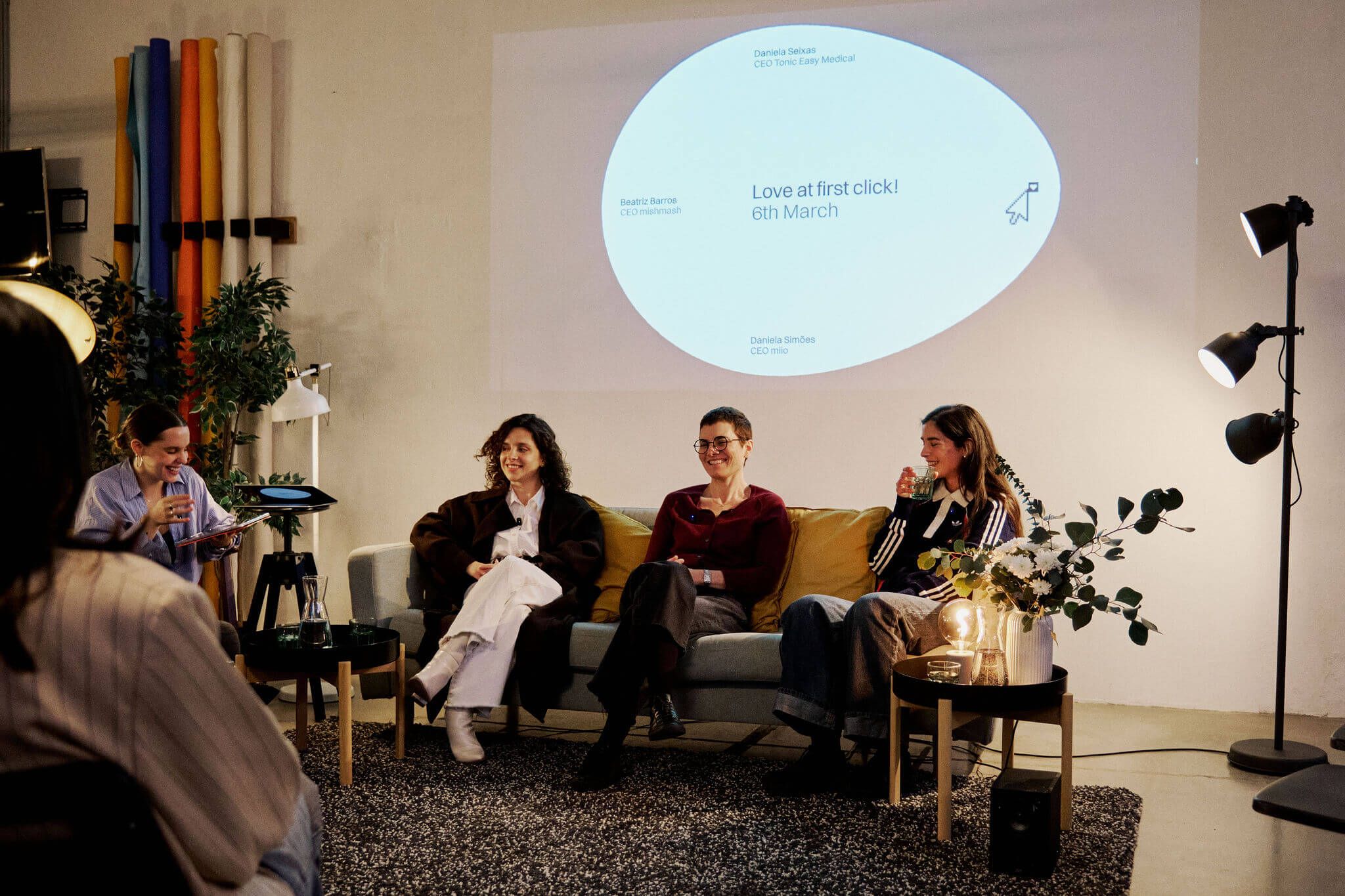
This article is part of a series drawn from Love at first click!, a conversation hosted at Significa on 6th March 2026 with founders Daniela Simões (miio), Daniela Seixas (Tonic Easy Medical), and Beatriz Barros (mishmash).
All pitches involve some version of the same question: what's differentiates your business? And the expected answers tend to sound alike. Proprietary technology, network effects, data advantages, first mover positioning. These atributes all fit neatly into a pitch deck and can be evaluated on a spreadsheet.
However, when Daniela Seixas and Beatriz Barros talked about what actually made their businesses unique, their answer didn't fit into any of those categories. It was something harder to measure and, as it turns out, considerably harder to replicate.
On obsession.
Beatriz founded mishmash, a Portuguese stationery brand that now sits in over 100 stores worldwide, including the Guggenheim in New York, with a team of three people. That fact alone is unusual, but the the market she chose to build in is as striking. Given that people write less, print less, and carry their notes in their pockets on their phones, paper-based stationery is a declining category. However, Beatriz decided to make people fall in love with paper again.
How she did it comes down to an almost unreasonable commitment to how her products feel. From the book-quality finishing on notebooks, to the weight of the paper and the way ink behaves on the surface, to the tactile satisfaction of handling something that was clearly made with care. These qualities are hard to capture in a spec sheet, but they're what convinced the Guggenheim museum to stock mishmash's products when Beatriz approached them, making it one of the brand's earliest and most significant stockists.
“Founders obsessed with what they're creating always manage to build a love brand.”
Beatriz Barros
Founder of mishmash
When your product inspires that kind of confidence in a buyer at the Guggenheim, it tells you something about the power of obsessive attention to quality. That reputation has carried mishmash into over 100 stores since, and it's very difficult to build through marketing alone.
Knowing when to trust your gut.
The conversation got particularly interesting when Beatriz and Daniela Seixas started comparing how they make decisions, because their approaches couldn’t be more different.
Beatriz describes mishmash as "very gut-driven." Her instincts are rooted in her grandfather's stationery shop, in years of touching materials and knowing what feels right before any data could confirm it. But she's thoughtful enough to recognise the limits of that approach. "Consumers often don't know what they want," she said during the conversation, so "Data is as important as instinct."
Daniela Seixas works very differently. At Tonic Easy Medical, decisions are driven by data: the company only tracks KPIs it can act on, and every move is measured and validated. But when it came to building its brand identity, Daniela chose a dedicated creative process with an external agency, guided by human intuition rather than metrics.
“With all AI capabilities now, I would never trade that human creative process. Never.”
Daniela Seixas
Founder of Tonic Easy Medical
So here's a founder who insists on data for product decisions but chose human intuition to design her brand. And alongside her, a founder who leads with gut instinct but acknowledges that data is equally important. Neither approach is wrong, and the interesting insight here isn't really about which approach is better. Knowing when to apply each, when to trust the numbers and when to trust your instincts, that in itself a form of expertise that tends to go unrecognised.
More than numbers.
Considering investors are trained to evaluate defensibility through technology, data, and distribution, this kind of expertise rarely comes up in fundraising conversations. They understand unit economics, acquisition costs, and lifetime value, but what they're less equipped to assess is the emotional layer of a business: the depth of customer relationships, the quality of internal culture, and the accumulated trust that determines how a company behaves when things get difficult.
These women built businesses where that emotional layer turned out to be their strongest asset. Beatriz's obsession with product quality created demand that bypassed traditional acquisition channels entirely. Daniela Seixas's commitment to rigorous standards, including CE certification and ISO compliance for an AI product in healthcare, built credibility in a market where trust is the price of entry. And Daniela Simões's transparency during miio's 2022 energy crisis, which we explored in the first article of this series, turned what could have been a catastrophe into proof that miio is truly there for their community.
None of these outcomes appeared in their original business plans, nor could any of them have been predicted by a financial model. But in each case, they became what made their business unique and genuinely difficult to compete with.
Ana Fernandes
Brand Manager
While others struggle to keep up, Ana effortlessly leaps from one thing to the next in a turbo-charged, blazing fast, whirlwind of flaming ideas and effortless creativity. After a couple of years managing projects, Ana moved into brand & product marketing. Now she shapes how Significa communicates with the world, keeping our voice clear, consistent, and genuinely ours.
We build and launch functional digital products.
Related articles
Tiago Duarte
CPO
27 October 2026
•
6 min read
Significa
Team
23 October 2026
•
6 min read
Rui Sereno
CEO