7 Aug 2026
•
5 min read
How AI search is changing business recommendations.
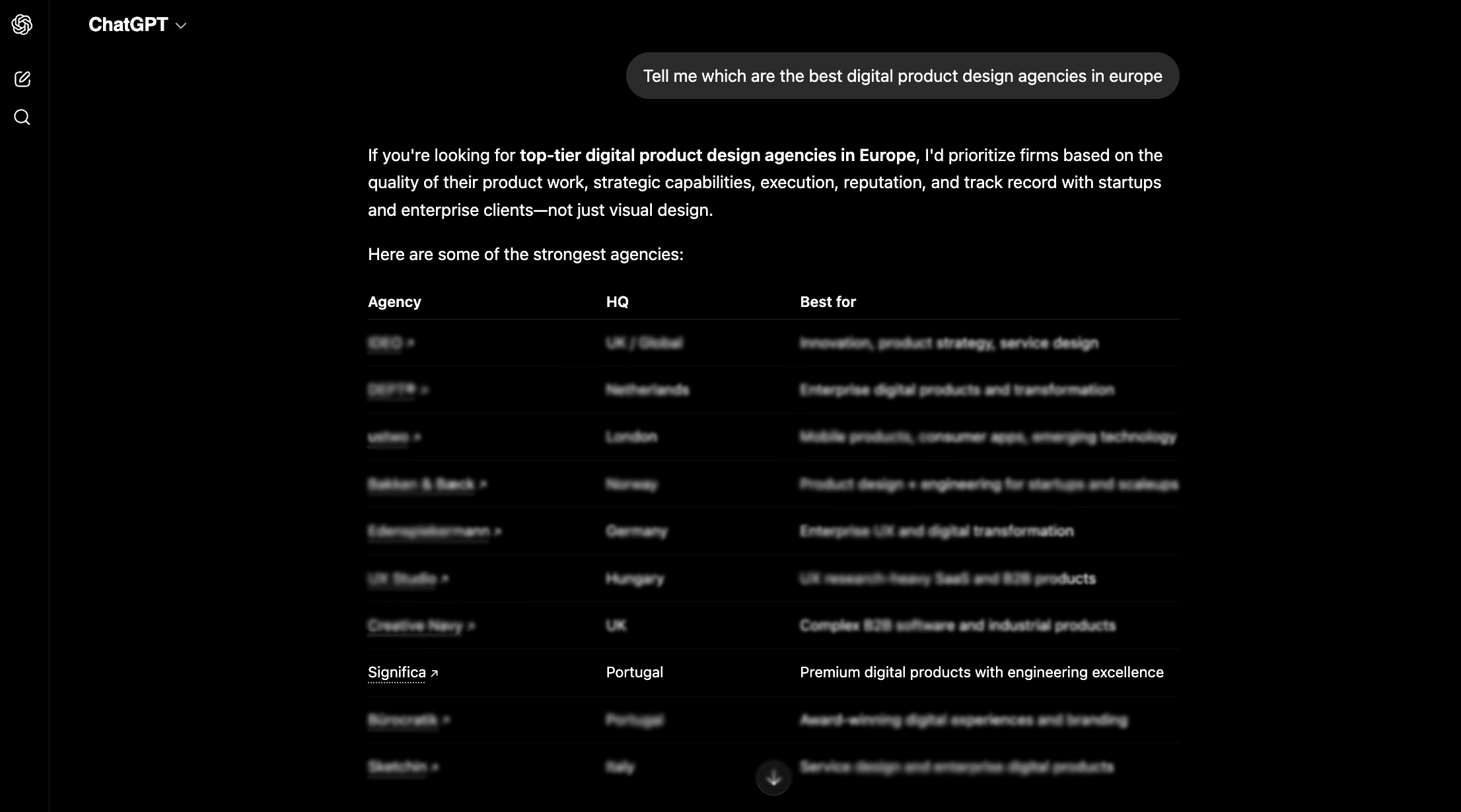
For ten years, new clients found us through Dribbble, word of mouth, and awards. Now, by asking AI.
Lately, more and more leads tell us they found Significa by asking a large language model (an LLM). A part of our funnel, which barely existed a year or two ago, is clearly becoming the most important one, and it arrived faster than expected.
Why this is happening
The mechanics are simple enough. Prompted, an LLM answers a question directly, in prose, drawing on everything it has read across the web. Ask it to recommend a product agency in Europe, or to explain how to migrate an e-commerce platform without breaking checkout, and what comes back is a written answer instead of ten blue links to sift through.
Google now opens a large share of results pages with an AI Overview of its own, written by its Gemini models from the same web content. This summary sits above the links people used to click.
We say 'used' because, as a 2025 Pew Research Center study found, people click through to a link on only around 8% of searches where one of these Overviews appears, against 15% where it does not.
A conversation with an LLM works differently, even though it may also hand you a list. Ask it for a recommendation and it returns a bunch of names, paired with complementary information that you weren’t even looking for. Now, compare that with a Google Search, which returns a ranked slice of the web for you to click through, and then you realise the game has changed: the former SEO battle is now shifting towards GEO.
What this means for any business
It mostly means that leads come from a different place, and more often than not, better informed.
If our GEO efforts succeed, we gain visibility in a far more targeted and seemingly agnostic way, because the LLM is perceived as something recommending us rather than ranking us. That carries a weight a ranked link never had. Where a similar level of targeting once required paid ads, now our content sets the target.
LLMs read much of the same web that search engines crawl, but they reward almost entirely different things. A page tuned to win an SEO ranking is not automatically what a model chooses to draw from. Models lean towards sources that say something clearly, that are specific, and that carry a point of view you could attribute to a named person or company. The thin, generic, keyword-stuffed pages that a decade of SEO produced in bulk give a model very little reason to reach for them.
How we're approaching it
Nobody has a settled method for this yet, and anyone selling you one with full confidence is guessing with conviction. So we treat it the way we treat most problems: test, measure, change, and go at it again. We have seen encouraging results, but for a while we could not tell whether they came from something we did or from plain luck, which is an uncomfortable place to make decisions from.
One thing has not changed, and it is the part that matters most. We design and build outstanding digital products, then make sure that quality is legible from the outside. An assistant cannot recommend work it cannot find, and it will not recommend work that says nothing distinctive. The qualities that earn anyone’s attention (clarity, specificity and a real point of view) are the ones a model favours as well: a Princeton study on generative engine optimisation found that adding concrete statistics to a page raised its visibility in AI answers by around a fifth, and adding direct quotations by more than a third.
Transparency helps too, and it is not a value we adopted for the occasion. Our handbook has been public for years, with rates included, on the logic that if you say you are transparent you should indeed be transparent. The more openly we explain how we work, the more there is for an LLM to go on, and the more consistently it reads as a trustworthy source.

Our Handbook
How we think, how we work, right down to our rates: it is all public. Have a read and hold us to it.
There is a harder truth underneath all this. Most of what shapes an LLM's answer does not live on your own site. Asked to name the best product or service provider within a category, a model leans far more on what the rest of the web says on directories, awards coverage, mentions in external articles, and recommendations buried in a forum thread, than on anything written on brand. Your own pages keep the record straight and give LLMs something clean to quote, but the verdict is mostly in other people's hands
Which, in turn, is how we were always found. Dribbble, word of mouth, ten years of awards: none of it was our copy, all of it was other people vouching for us in public.
None of this, though, told us whether our efforts were working. We do not control whether an assistant mentions us, and for a long time we could not even see whether it did. There is no ranking dashboard for this and no clean feedback loop to read. So we built one.
Lens
Lens is a performance intelligence platform we built to close the gap between marketing efforts and their efficacy. Most of it reads across a client's commerce, analytics, search and social data and turns the numbers into plain-language analysis, but the part that matters here is its AI Visibility module, which watches how a brand shows up across the major assistants like ChatGPT, Perplexity and Gemini, against a defined set of competitors.
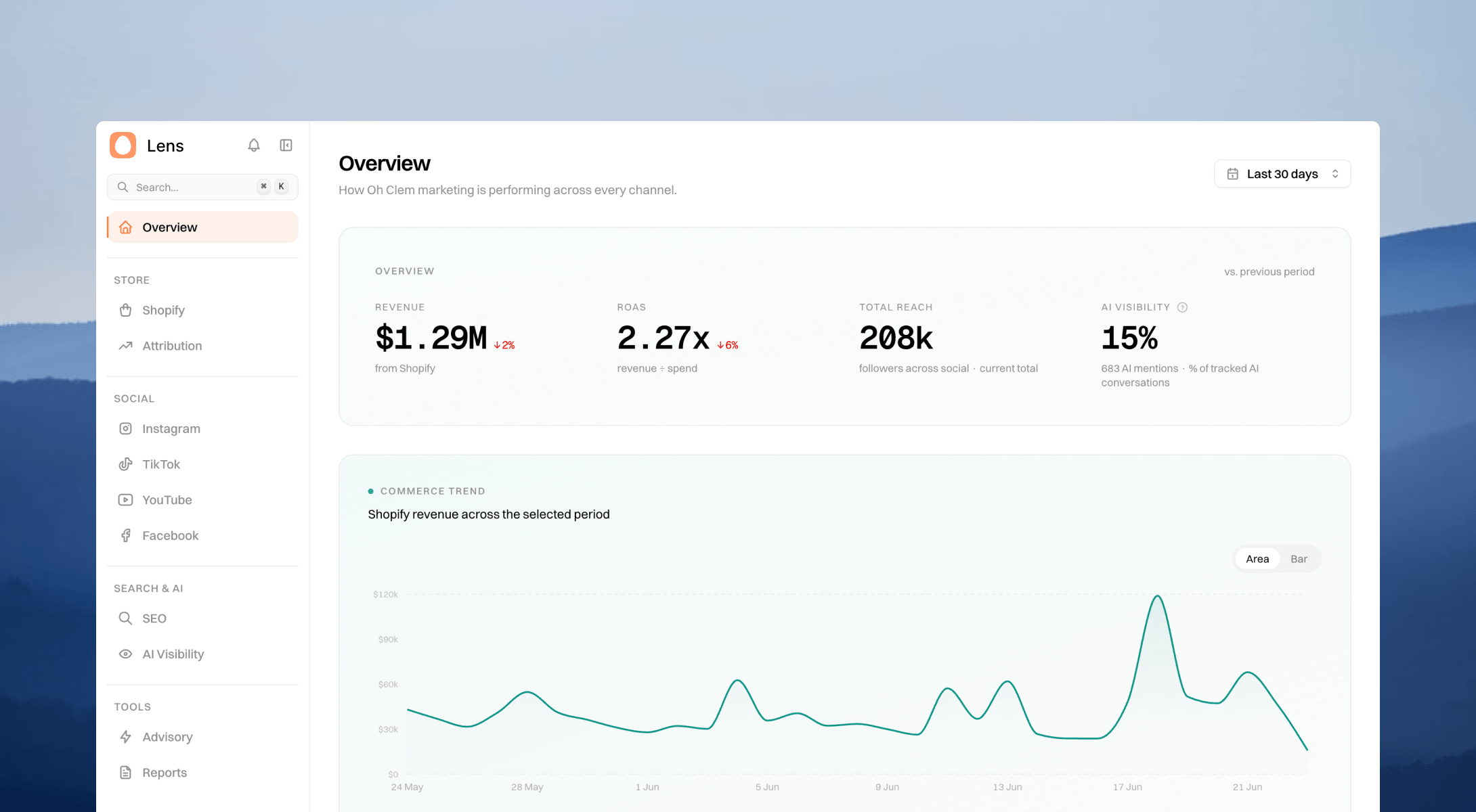
It reports four things in plain terms: how often you appear when LLMs are asked about your category, your share of those mentions against competitors, the tone the models use when they describe your business, and where you rank when you are mentioned. It also flags the prompts where a competitor turns up and your business doesn’t, and which sources the models lean on most in your field, which shows you where the recommendation is being formed in the first place.
The prompts Lens watches are chosen from what we know of a client's market and what we see in how people really search, because a visibility score is only as good as the questions that produced it. We run all of it on ourselves first, which is how we know our own name is turning up in these answers. It has not solved the problem, and I would not claim it has. What it gives us is insight: we can watch our visibility move and see what changed when it did, which is firmer ground than hope, and the first solid footing we have had on this.
Questions you might be asking
Is AI search replacing Google?
Not outright, and not yet, but it is changing what a search is, and two shifts are running at once. Google now answers a growing share of queries with an AI Overview before it shows any links, so people read and stop. Separately, many skip the search box altogether and ask an LLM like ChatGPT directly. The first erodes the click that used to follow a search, and the second replaces the ranked page of the web with a shortlist it has already chosen.
What is generative engine optimisation?
It is the emerging practice of writing and structuring content so that AI assistants are more likely to surface and cite it, much as search engine optimisation set out to win rankings on Google. The discipline is recent and largely unproven, so we treat its methods as informed bets and experiment loosely.
How can a business improve its chances of being cited by an AI?
There is no guaranteed method, but the sensible bets rhyme with good writing. Say something specific and worth quoting, hold a clear point of view, attribute it to real people and dates, and publish openly and consistently. Thin, hedged, keyword-led pages are the least likely to be chosen.
How does Significa help with this?
We build digital products, and the content around them, to be clear, credible and findable, whether the reader is a person or a model. If discovery is shifting under your business, it is one of the things we are working through in the open, for our clients and for ourselves.
What we don't know yet…
Plenty. We do not know how durable today's behaviour is, or how the assistants will handle attribution and linking as they mature, or whether the traffic moving to them will convert the way search traffic did. We do not know whether there is a dependable way to be present in an answer, or whether presence will always carry an element of chance. I will not pretend we have solved it. What we are sure of is the direction, so we are choosing to learn it early, while it is still messy, before the certainty arrives secondhand and everyone has it at once.
Better Mistakes Podcast
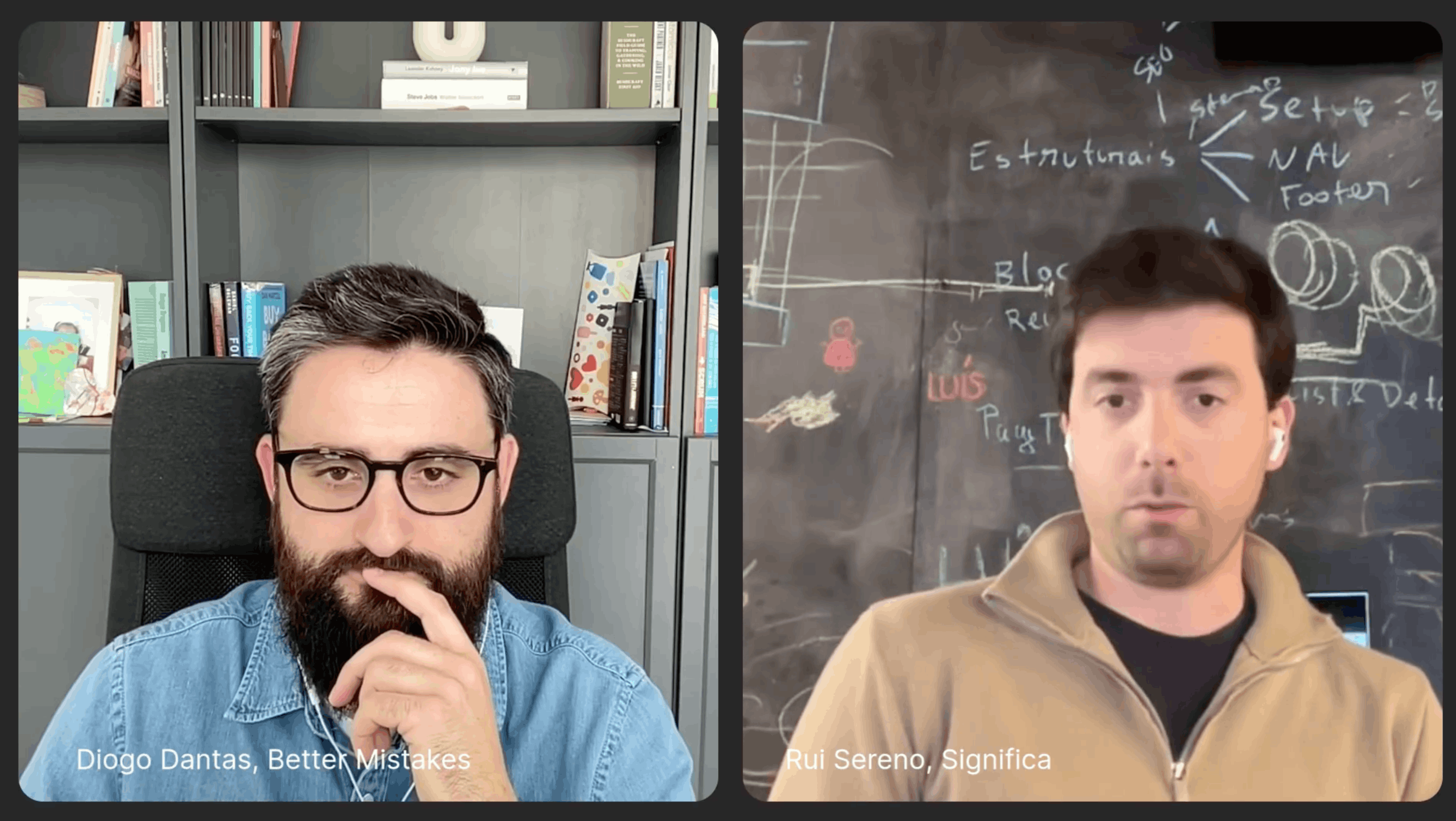
This piece began as an offhand answer to a closing question from Diogo Dantas, who asked what I am currently struggling with. The full conversation runs wider, from how we have stayed independent for a decade, to why we keep our team deliberately small, to how we price work now that AI is in the room.
What’s next?
For ten years, our best salespeople were the clients happy enough to recommend us to someone else, and that has not changed, only now the recommendation can come from a machine too. We have not figured this out yet, and knowing us, we may never quite feel that we have. But whatever makes an LLM put your business forward looks a great deal like whatever made a human do it: doing outstanding work, whether that is a product or a service, and being clear about how and why. Much as we did in the early days, we are faking it until we make it.
Rui Sereno
CEO
A long time ago Rui decided to put his glory days as a designer behind his back to embrace the Managing Partner role at Significa. Now, no one knows exactly what he does when he’s not playing Nintendo. He believes himself to be the deserving Significa 2020, 2021, and 2022 Cook-off champion and is having a hard time acknowledging the truth.
We build and launch functional digital products.
Related articles
Rui Sereno
CEO
Rui Sereno
CEO
10 August 2026
•
4 min read
Tiago Duarte
CPO